

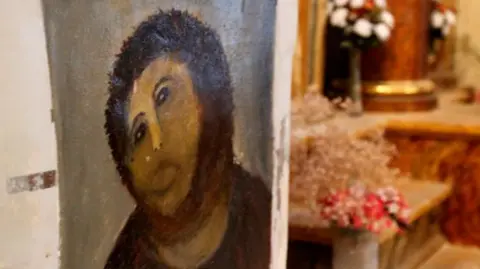
The Spanish parishioner who achieved global fame for her poorly executed repair job on a valuable religious painting has passed away at the age of 94.
The woman, a resident of the town of Borja in northeast Spain, became a global sensation 13 years ago after she attempted to restore a 100-year-old fresco titled Ecce Homo housed within her local church.
Giménez's restoration effort spread across the internet and was dubbed "Potato Jesus", because the resulting depiction of Christ's head looking somewhat like a furry primate.
Local Announcement and Tribute
The 94-year-old's death was confirmed by the town's mayor, Eduardo Arilla, via an online statement, where he acknowledged her as a "passionate enthusiast of painting from a very early age".
"Descansa en paz Cecilia, your memory will live on with us," the mayor posted.
Arilla also paid tribute to Giménez's "famous restoration of Ecce Homo" in August 2012, which "because of the deteriorated condition it was in, Cecilia, with the best intentions, decided to apply new paint over the original".
The Painting's Background and the Now-Infamous Act
The Ecce Homo ("Behold the Man" in Latin) painted by nineteenth-century artist Elias Garcia Martinez had been held for over a century in the Santuario de la Misericordia close to Zaragoza.
At the time, Giménez, who was 81 years old, stated that church members had "traditionally fixed everything here", and that she had been given the go-ahead from the parish priest to do the work.
She added at the time that anybody who came into the Church would have seen she was applying paint to the existing image.
A Surprising Tourist Boom
The impact of the restoration led to the creation of the "Ecce Mono" internet phenomenon and transformed the previously sleepy town of Borja rapidly turn into a major tourist destination.
The town, which had in the past welcomed just five thousand tourists per year, attracted over 40,000 tourists by 2013, and managed to raise more than €50,000 for charity from the interest.
Currently, officials estimate that between 15,000 and 20,000 tourists travel to Borja every year to view the famous portrait, which is now displayed behind a pane of glass.
Legacy and Community Support
Following the wave of criticism, backed by the townspeople and others around the world, Giménez later stage an exhibition of her paintings featuring 28 of her personal paintings.
She was commended by Borja's mayor for her kind-hearted nature and decades of faithful service to the church.
In the end, what began as a well-intentioned but flawed act of restoration created an improbable piece of pop culture and provided unprecedented attention and resources to a small Spanish town.


